
If you’ve thought seriously about flying private, you’ve probably hit the same hurdle everyone does: a six-figure check before you ever board the aircraft.
Starting November 12, 2026, that hurdle is gone.
New Co-Lease puts you on a factory-new Cessna Citation CJ4 Gen2 with no up-front cost. You pay monthly, choose 10, 20, 30, or 40 travel days a year, and your agreement runs for as long as your aircraft is scheduled to remain in the Jet OUT fleet, up to five years.
This isn’t Co-Lease 10 and Co-Lease 20 with a new name. The program was rebuilt from the foundation: a new term, a new payment structure, new travel-day options and new repositioning coverage. Here’s what changed, what didn’t, and how to tell whether it fits the way you fly.
What’s new in Co-Lease?
-
The big up-front payment is gone. The previous program asked for a six-figure payment up front. New Co-Lease replaces it with monthly payments. Set up autopay by ACH or credit card and there’s no buy-in at all. Your first monthly payment is due at signing, and that’s the extent of it.
-
Your term matches your aircraft. Instead of a 12-month agreement, yours runs for as long as your aircraft is scheduled to stay in the fleet, to a maximum of five years.
-
More ways to size your year. Two options became four: 10, 20, 30, or 40 travel days, deposited into your personal day bank.
-
More of the trip to you is covered. Every new agreement includes Home Zone and Extended Zone coverage, so we may pick up more of the cost of getting the aircraft to and from your airport, depending on your location.
How travel days work
Think of a travel day as a calendar day, not a flight. If the aircraft flies for you that day, it counts as one. Within it, fly multiple legs, change your itinerary, or fit in a quick round trip. A morning meeting two states away and dinner at home still adds up to a single day.
Three rules worth knowing up front:
-
Unused days roll over, with no cap. Rolled-over days need to be used in the first quarter of the following year.
-
Blackout dates apply only to the 10-day option, which has 10 a year. The 20, 30, and 40-day options have none.
-
Empty legs earn you credit. Share an eligible flight with another Co-Owner or Co-Lessee through our Empty Leg Program, and you earn a partial travel-day credit.
What Co-Lease costs
Two parts, nothing hidden: a monthly fee based on how many travel days you choose, and an hourly cost for your time in the air. The hourly rate is the same whichever option you pick, so moving from 20 days to 30 changes your monthly fee, not what you pay per hour.
Want the actual numbers for the way you fly? The Cost Calculator shows what each option costs and puts Co-Lease and Co-Ownership side by side.
Where we pick you up
Each regional base has its own Home Zone. If your trip starts or ends inside it, there’s no repositioning cost. Choose your airport, and the aircraft meets you there.
Beyond that is the Extended Zone, which reaches twice as far. There, we cover at least half the repositioning cost, and the closer you are to base, the more we cover. You’ll find the zone maps on our regions pages.

What hasn’t changed
Everything you’d notice on travel day. Co-Lessees fly the same factory-new Citation CJ4 Gen2 aircraft, with the same crews and operating standards, as our Co-Owners. Every CJ4 Gen2 seats eight.
We still fly from regional bases in Milwaukee, Miami, Scottsdale, and Dallas-Fort Worth. Local pilots and maintenance teams support each aircraft, and one central dispatch team coordinates trips across the network.
Co-Lease vs. Co-Ownership: what’s the difference?
Both put you on the same aircraft with the same crews. So the real question is a simple one: do you want the asset on your books?
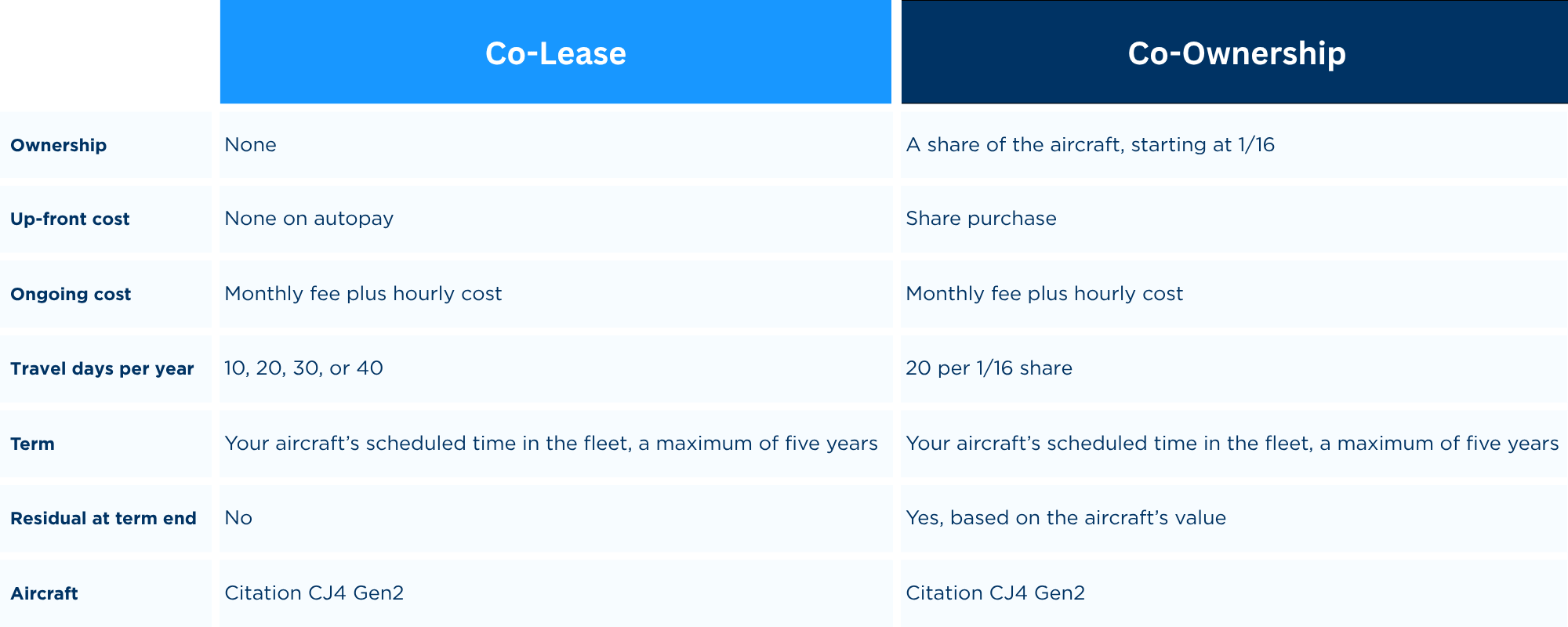
Co-Ownership makes sense if you want the aircraft on your books. Ownership may deliver tax advantages. We don’t provide tax services, so we recommend talking with a tax professional about your situation.
Co-Lease makes sense if you want private flight without a large up-front payment. Same aircraft, same crews, paid monthly.
Isn’t this just a jet card?
No. It’s also not a fractional share or a membership program.
Jet card terms vary by provider, and many ask you to prepay a balance or a block of hours. Co-Lease doesn’t ask for a prepaid balance. Your agreement is tied to a specific aircraft in our fleet, flown by pilots and maintained by teams based where you fly.
What happens to my Co-Lease 10 or Co-Lease 20 agreement?
Nothing changes until your current term ends. When it does, you can renew under the new Co-Lease and choose the travel-day option that fits. We’ll walk you through the new terms side by side with your current agreement, so the choice is clear before you make it.
Find your travel days
Start with how often you fly. Run your numbers through the Cost Calculator, then let’s talk about the option that fits your travel needs.